
Are Advertisers Stuck in Old Habits? Breaking Away from the Clicks-First Mindset (Part 5)

Updated: Jan 21
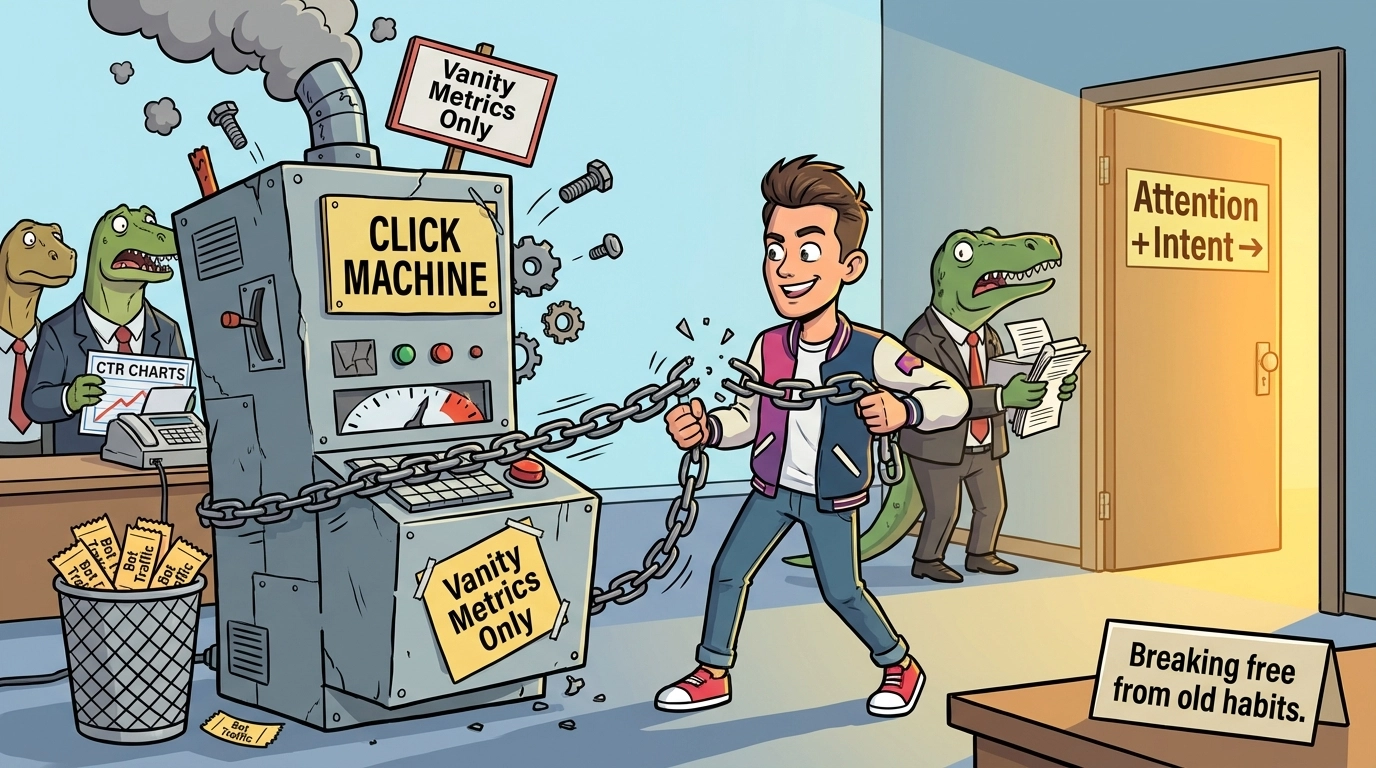
Cartoon caption: A marketer snaps "Clicks-First" chains as a wheezing Click Machine scatters bolts; suit-wearing dinosaurs cling to CTR charts while the exit to "Attention + Intent" glows.
As we wrap up this five-part series exploring the critical shift from clicks to engagement, there's one final question that demands an honest answer: Are Australian advertisers genuinely ready to abandon the metrics that have guided their strategies for over a decade?
The uncomfortable truth is that many remain trapped in outdated measurement frameworks, despite mounting evidence that clicks-first thinking is killing their campaigns. However, 2025 has also revealed something encouraging: the brands that have successfully broken free from these legacy habits are absolutely dominating their markets.
The Old Habits Die Hard
Traditional digital advertising has conditioned an entire generation of marketers to chase the wrong metrics. The playbook seemed simple enough: optimise for lower costs per click, celebrate high click-through rates, and measure success by the volume of traffic driven to websites. Dashboard screenshots filled with impressive engagement numbers became the currency of campaign success.
Yet beneath these vanity metrics, a devastating reality has emerged. Clicks divorced from context generate worthless traffic. High volumes of unqualified leads drain sales resources. Fraudulent engagement signals manipulate algorithms whilst haemorrhaging genuine marketing budgets. The very metrics we've relied upon have become weapons turned against us by sophisticated bad actors gaming the system.
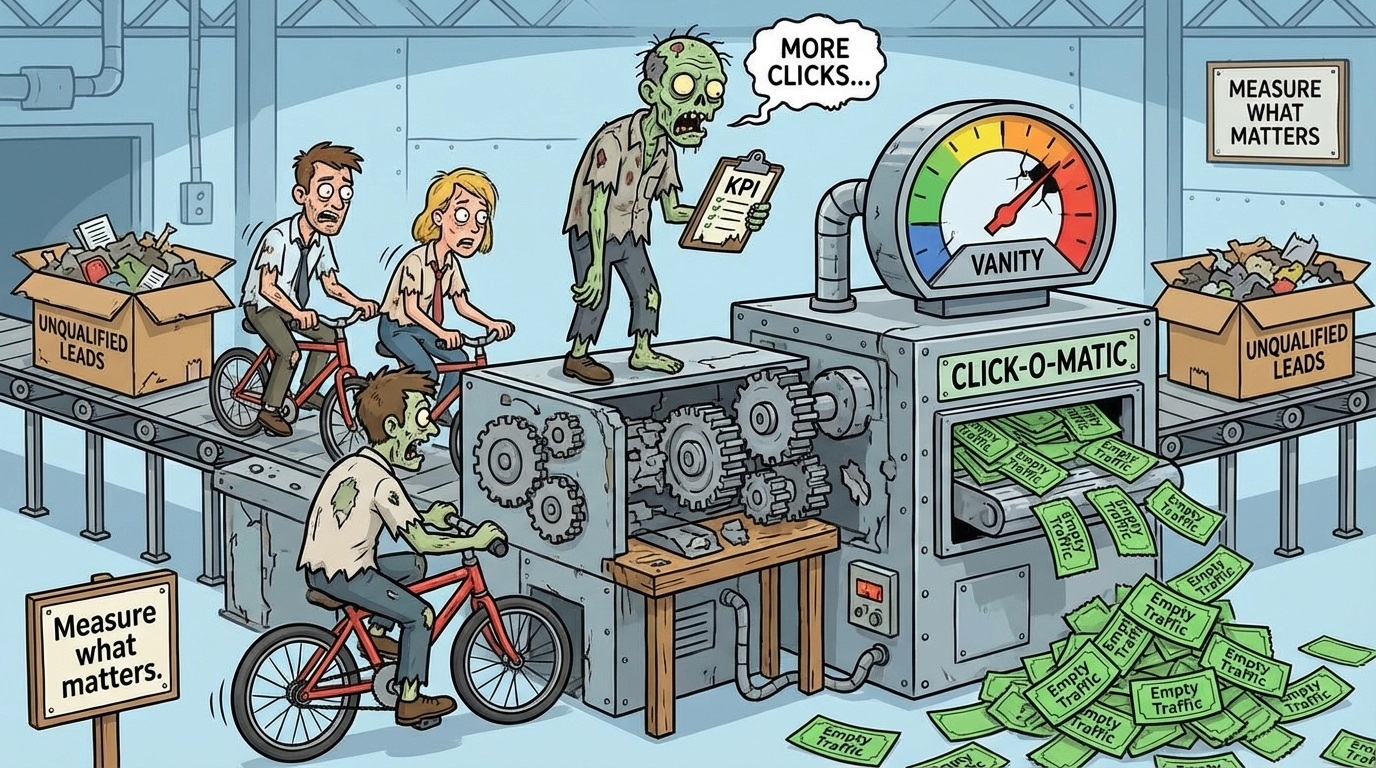
Cartoon caption: Marketers pedal a rickety Click-O-Matic spewing "Empty Traffic" while a KPI zombie groans for "More clicks..." Measure what matters.
The research is now undeniable: traditional click-focused metrics demonstrate virtually no correlation with actual revenue generation. A campaign can appear wildly successful in reporting dashboards whilst simultaneously destroying profitability. This disconnect has created an industry-wide measurement crisis that demands immediate attention.
What Actually Works in 2025
Forward-thinking Australian brands have already identified the solution. The winners have abandoned click-chasing entirely, instead building their strategies around meaningful engagement signals that correlate directly with business outcomes.
Quality Pipeline Over Raw Volume
The measurement philosophy has undergone a fundamental reset. Leading teams now prioritise qualified pipeline creation over raw lead volume. Cost per qualified lead has replaced cost per click as the primary success indicator. Lead-to-opportunity conversion rates matter more than click-through rates. Revenue attribution focuses on identifying which channels accelerated sales, not just which generated initial touchpoints.
This shift requires sophisticated tracking capabilities, but the payoff is enormous. Brands measuring qualified outcomes consistently report lower acquisition costs and higher lifetime customer values compared to those still chasing vanity metrics.
Attention Metrics Replace Legacy Benchmarks
Click-through rates and viewability scores are being superseded by attention metrics as the true measure of advertising effectiveness. High-attention advertisements deliver tangible results: research indicates a 130% lift in conversions and a 51% reduction in cost per action when campaigns optimise for sustained user focus rather than initial clicks.
The distinction is crucial: advertisements must not simply be seen; they must capture and maintain audience attention to drive meaningful outcomes. This represents a fundamental shift from measuring exposure to measuring engagement depth.
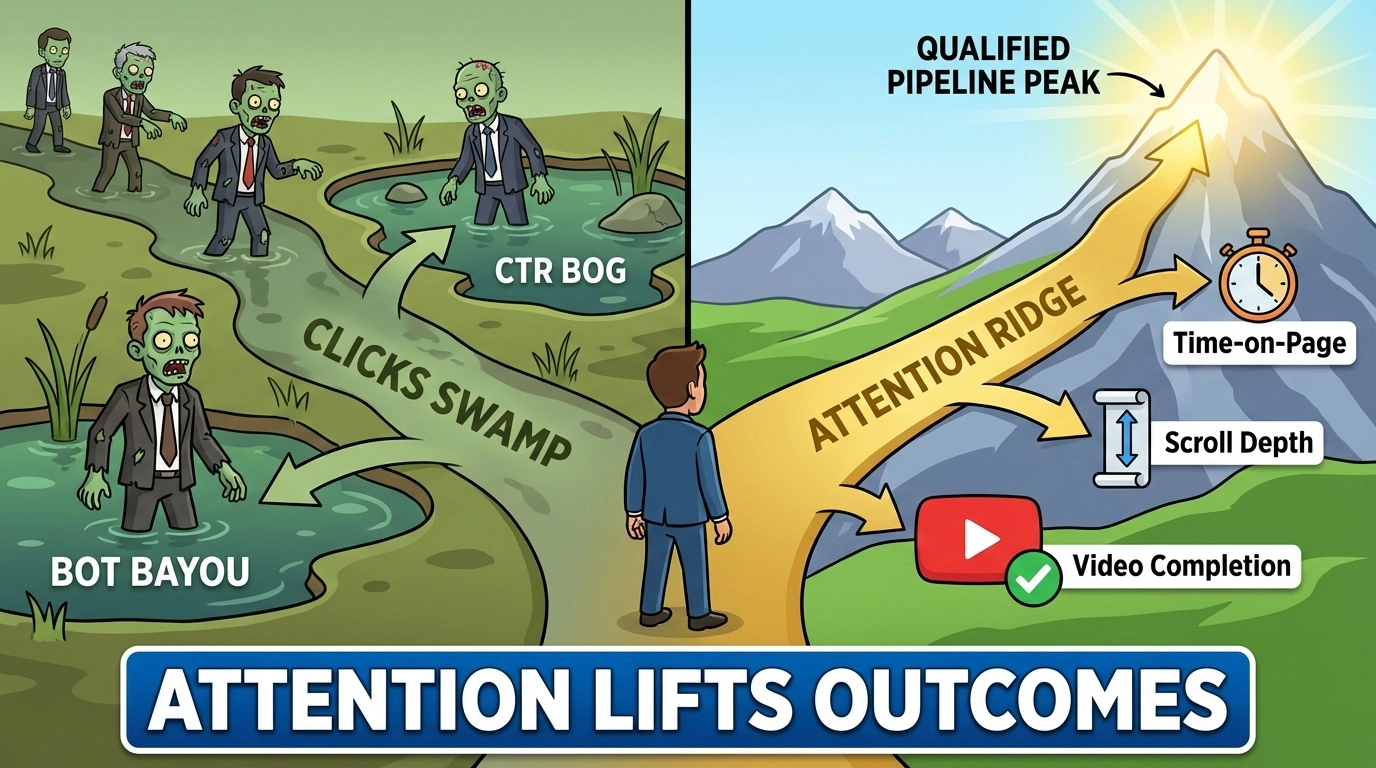
Cartoon caption: Two paths diverge — "Clicks Swamp" with metric zombies vs "Attention Ridge" leading to "Qualified Pipeline Peak." Attention lifts outcomes.
Creative Becomes the Primary Targeting Mechanism
Privacy legislation has stripped away granular demographic targeting controls, forcing a radical rethinking of how advertisements reach intended audiences. The breakthrough insight: creative content itself has become the new targeting mechanism.
Modern algorithms rank content based on engagement within the first few seconds of exposure. If an advertisement's angle resonates immediately, platforms push it further, which automatically increases lead volume whilst reducing costs. This creates a virtuous cycle where strong creative drives both reach and efficiency.
Top-performing creative in 2025 employs specific psychological angles:
Demonstrating the cost of inaction
Revealing mistakes audiences don't realise they're making
Providing immediate problem-solving frameworks
Highlighting overlooked pain points
Offering shortcuts to desired results
Exposing unnecessary complexity through process comparisons
The pattern is clear: advertisements that educate outperform those that sell. Content that demonstrates beats content that describes. Transformational messaging defeats feature-focused copy.
The Practical Roadmap to Breaking Free
Australian brands ready to abandon clicks-first thinking need a systematic approach to implementing engagement-focused strategies. Here's the proven framework that's delivering results:
Step 1: Audit Your Current Measurement Stack
Begin by identifying every metric currently tracked in your campaigns. Create two columns: "Vanity Metrics" and "Revenue-Correlated Metrics." Be brutally honest about which measurements actually predict business success versus those that simply look impressive in reports.
Common vanity metrics to eliminate: raw click volumes, impressions, basic engagement rates, and unqualified lead counts. Revenue-correlated alternatives: qualified lead conversion rates, pipeline velocity, customer acquisition cost, and lifetime value ratios.
Step 2: Implement Attention-Based Optimisation
Replace traditional engagement metrics with attention-focused measurements. Track time spent viewing content, scroll depth on landing pages, video completion rates, and multi-touchpoint interaction patterns. These signals correlate strongly with purchase intent and sales outcomes.
Platform algorithms increasingly reward content that maintains user attention. Optimising for these signals improves both organic reach and paid campaign efficiency.
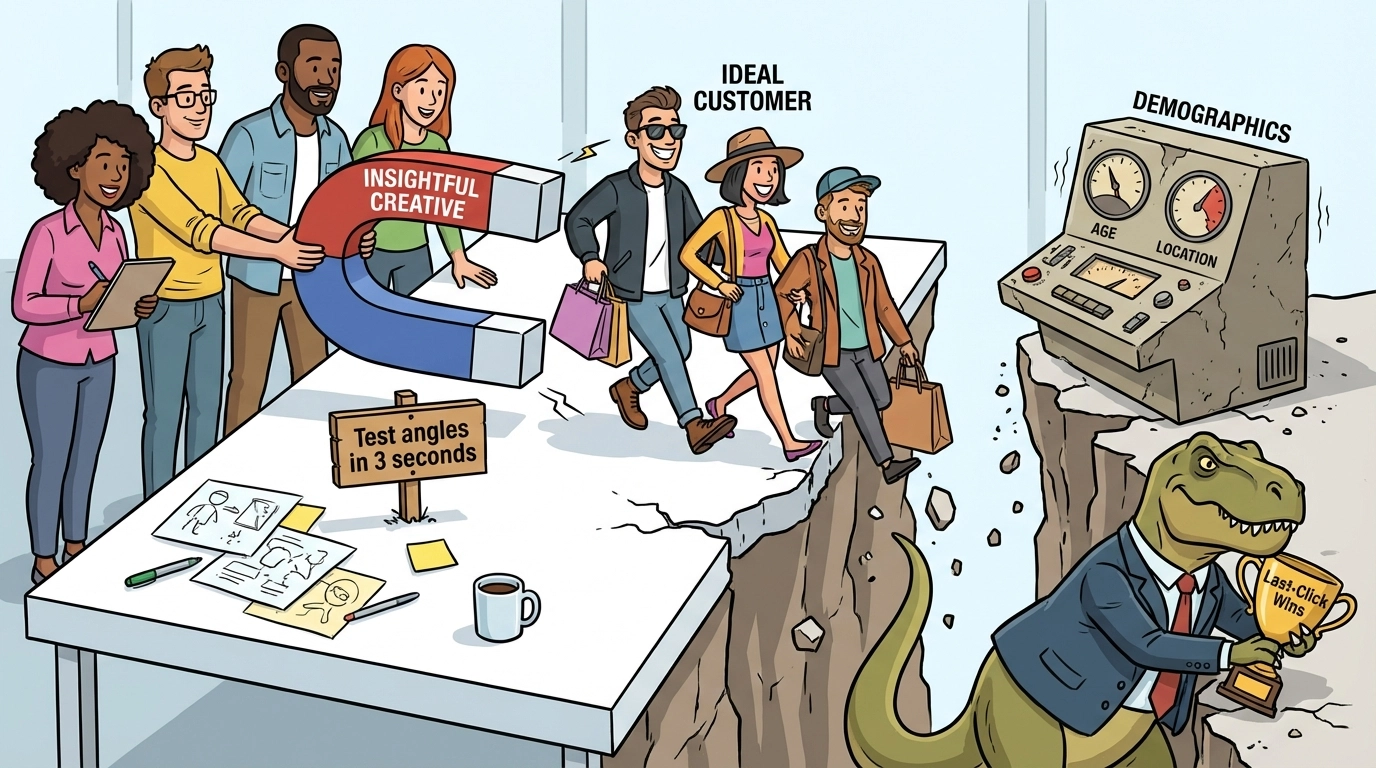
Cartoon caption: An "Insightful Creative" magnet carries ideal customers across a chasm as dusty demographic dials fall off; a media-buying dinosaur clutches a "Last-Click Wins" trophy.
Step 3: Rebuild Creative Strategy Around Intent Signals
Develop advertisement variations that test different psychological angles rather than demographic segments. Create content that addresses specific problem states, desired outcomes, and decision-making frameworks relevant to your audience.
Test creative hooks within the first three seconds of video content or above-the-fold positioning for static advertisements. The algorithms will rapidly identify which angles generate sustained attention and automatically scale successful variants.
Step 4: Align Landing Experiences with Advertisement Promises
Ensure seamless continuity between advertisement messaging and landing page experiences. Misalignment between ad promises and page content destroys conversion rates regardless of how compelling the initial creative might be.
Strong advertisement angles must be supported by landing pages that continue the conversation rather than generic corporate messaging. This alignment dramatically improves qualified lead generation whilst reducing cost per acquisition.
The Competitive Advantage of Early Adoption
Brands viewing lead generation as an end-to-end advertising pipeline: rather than isolated click events: are dominating their sectors in 2025. They understand that weak creative produces weak leads, whilst strong advertising angles strengthen entire sales funnels.
The most valuable insight: lead generation is no longer about chasing cheaper clicks. Success depends on attracting genuine intent through strong advertising fundamentals. Marketing budgets flow toward campaigns driving meaningful pipeline, not impressive vanity metrics.
Teams building strong creative angles gain platform reach, sustained attention, and higher-quality leads simultaneously. Meanwhile, brands still describing products rather than solving problems struggle with rising acquisition costs and deteriorating lead quality.
This isn't a gradual transition: it represents a hard reset in what actually works. The brands thriving in today's environment understood these changes early and adapted quickly. Those still optimising for clicks face increasingly difficult competitive conditions.
Time to Choose Your Path
The evidence is overwhelming. Australian advertisers have reached a crossroads where the choice between clicks-first thinking and engagement-focused strategy will determine market position for years to come.
The old habits that seemed safe and familiar have become liabilities. The new approaches that initially appeared risky have proven themselves through measurable business outcomes.
Your competitors who've already made this transition are capturing market share whilst you debate the merits of change. The question isn't whether this shift will continue: it's whether your brand will lead the transformation or be forced to follow.
The measurement frameworks exist. The creative strategies are proven. The competitive advantage awaits those bold enough to abandon comfortable mediocrity for meaningful results.
What's holding you back from making the switch?
The Clicks v Engagement Debate
The Clicks v Engagement Debate is a five-part thought leadership series exploring how modern brands are moving beyond clicks and impressions toward smarter, more meaningful engagement metrics. It examines the limitations of traditional digital reporting and highlights how leading marketers are reshaping their measurement frameworks for real commercial impact.
The Click v Engagement Myth: Why brands need to stop chasing empty numbers
Are brands finally waking up to engagement? How modern marketers are changing their playbook
Fake news, fake traffic, and what advertisers get wrong about online success
Smarter metrics for brands: Measuring what really matters in the digital age
Are advertisers stuck in old habits? Breaking away from the clicks-first mindset

Comments